
Chosen beats found.
AI mentions don’t drive growth. Recommendations do.
Our inboxes and LinkedIn feeds have filled up with companies offering to measure how visible our brands are in AI. It's as if people scurried home from Cannes having heard a keynote or two and thought "what's the fastest way to AI-ify our brand tracking offering?"
But what’s being measured (visibility, discoverability, mentions), are a step or two removed from what marketers actually need to know:
“Does AI recommend me?”
That's not a pedantic distinction. For twenty-five years, being found was the whole game. You ranked, you got your share of the clicks, and even position seven earned something. Think of it as the difference between being on the shelf and being in the cart. The old game rewarded you for being on the shelf. AI means getting rewarded when you’re the item in the cart. Someone asks a question, they get an answer, and you're either it or you're decoration.
Many brands are doing everything they can to get seen and on the shortlist. But that's not enough to get chosen.
What we did
Our Brand Iceberg Model has a whole facet devoted to how brands earn their place inside AI-mediated buying journeys. The theory came from interviews with senior marketers. What it didn't have was proof. So we went and got some.
Seven categories across consumer and B2B, eight brands in each, and over 2,600 AI responses logged across ChatGPT, Gemini and Perplexity, with queries aligned to the IAB's Measuring Visibility in the AI Era.
What doesn't work
We measured four dimensions in our study: whether a brand shows up, whether it surfaces unprompted when someone describes a need, whether it makes the shortlist, and whether it gets named as the answer. The first three are so tightly correlated they behave like a single measure.
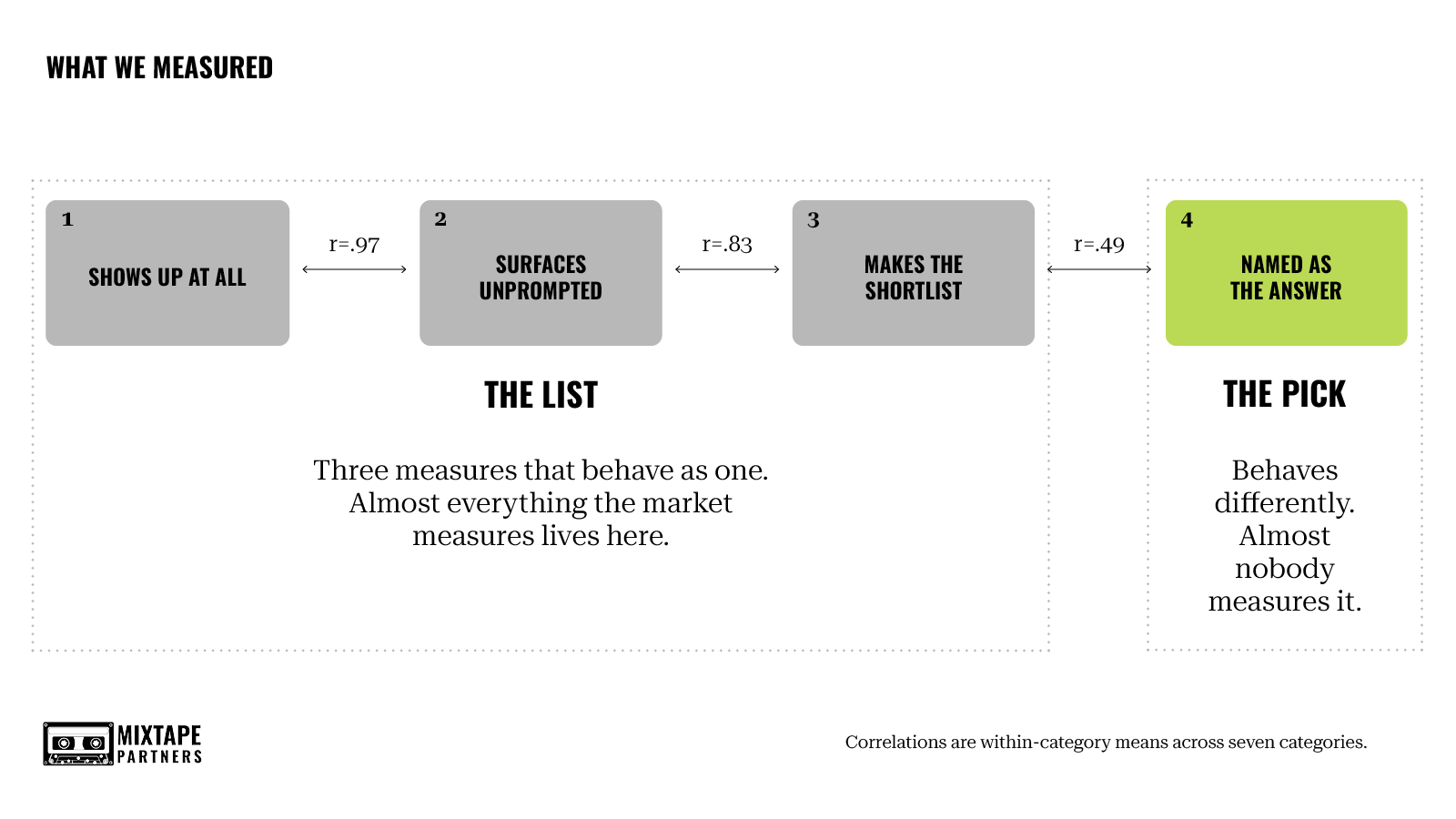
So, we're really talking about:
The list. Do you show up, do you come to mind unprompted, do you make the shortlist. Almost everything the measurement market currently sells to marketers lives here.
The pick. Are you the single "this is the one for you" recommendation. Almost nobody measures this.
Half the brands we looked at never got named as the sole recommendation. Not once, in any scenario we tested. And plenty of those were sitting on almost every shortlist in their category.
None of which is a knock on the discoverability tools. They measure what marketing has always measured: reach, awareness, presence. Presence was a reasonable proxy for consideration, and consideration a reasonable proxy for growth. The chain held. Our data says it now breaks at the last link.
Presence still tells you something. Just not whether you'll get chosen.
Let's say it clearly: being visible doesn't make you the recommendation.
What does work
Two things do most of the work, and they operate in sequence rather than in parallel.
Authority Signals. Reviews, rankings, press coverage, analyst recognition, the judgments other people make about you in places AI can reach. These determine whether AI treats you as eligible to be the answer at all. Each step up on this dimension multiplies the odds of ever being named the single recommendation by roughly two and a half. It's also the one element you can't manufacture, because it isn't yours to publish. That's why it works as a gate.
Category Mapping. Not your product pages, but content built around the specific situations your customers find themselves in. In our study, 85% of the outright wins landed on situations the brand had explicitly addressed with its own content.
Neither substitutes for the other. A brand at the bottom of the scale on both has roughly a one in ten chance of ever being the single recommendation in its category. A brand at the top sits closer to three in four. There's a third lever, less tested, and almost nobody is using it:
Comparison Content. Putting yourself against named alternatives on your own site. Fewer than a third of the brands we looked at published any, which makes it the widest open gap we found, but the evidence that it works is the thinnest. Promising rather than proven.

So what does this mean?
Before you touch your below the waterline strategy, work out what problem you actually have. The brands that never got recommended all landed in the same place on a scorecard, but they didn't get there the same way.
Mistaken identity. AI didn't know who they were, or confused them with something else. Rarer than the other two, and more urgent, because nothing downstream works until it's fixed.
Missing. Not misidentified. Just absent from the conversations where their customers were deciding.
Never the pick. The largest group. Everywhere and nowhere. Trusted, consistently named, described as credible, and passed over every time.
Most dashboards score those three the same. The fixes aren't interchangeable, and the move that solves an absence problem can waste a year of budget for a brand that's already on every list.
These aren't independent boxes to tick. The answer to most of them turns out to be a brand strategy question wearing a technical costume. Fixing your schema doesn't help if you haven't decided what you're for.
That's the work. Not a checklist. A strategy.
The category leaders are not winning this by default. Some of the most trusted, best-resourced brands we looked at are shortlisted constantly and chosen almost never. That's an opening for anyone willing to do the work now.
Making the list was the old game. Being the pick is the new one.